
- ISBN
- 9798233227813
- Genre
- Algemeen
- Verschenen
- 22-03-2026
- Bindwijze
- Ebook EPUB
- Taal
- Engels
- Uitgever
- ?Dr Naim Tahir Baig
- Auteur(s)
- Dr Naim Tahir Baig
BOOK DESCRIPTION
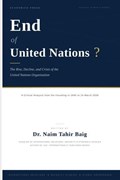
End Of United Nations?
The United Nations and the Failure of Collective Security, 1945–2026
By Dr. Naim Tahir Baig
In the eighty years since fifty nations signed the Charter of the United Nations in San Francisco, the organisation created to "save succeeding generations from the scourge of war" has presided over the Rwandan genocide, the Srebrenica massacre, the destruction of Syria, and the ongoing catastrophes in Ukraine, Gaza, and Sudan. It has watched a permanent member of the Security Council invade a sovereign neighbour — and then veto the Council's response. It has issued over three hundred vetoes, the overwhelming majority deployed not to prevent aggression but to shield it. And in January 2026, its Secretary-General warned all 193 member states that the institution faced "imminent financial collapse."
End of UNO? is the definitive analytical account of how the world's most important multilateral institution has failed, systematically and repeatedly, to perform the duties for which it was created. Spanning the full arc of UN history — from the Atlantic Charter of 1941 to the Trump administration's withdrawal from sixty-six international organisations in January 2026 — Dr. Naim Tahir Baig, one of the most prolific scholars of international relations writing today, traces the structural, political, and institutional causes of failure with meticulous precision and unflinching honesty.
Across twelve chapters, the book examines the founding compromises that embedded the seeds of dysfunction in the Charter itself; the Cold War paralysis that rendered the Security Council a spectator to superpower competition; the catastrophic failures in Rwanda, Srebrenica, and Somalia that exposed the gap between mandate and will; the Iraq war that proved the world's most powerful nation could bypass the Council with impunity; the death of the Responsibility to Protect in Syria and Libya; the triple crisis of Ukraine, Gaza, and Sudan that defines the present moment; the weaponisation of the veto as a shield for atrocity; the financial near-collapse driven by chronic non-payment of assessed dues; the internal decay of corruption, sexual exploitation scandals, and bureaucratic bloat; and the existential crisis of 2025–26 that has brought the institution closer to irrelevance than at any point in its history.
This book does not argue that the United Nations should be abolished. It argues that the United Nations, in its current form, cannot survive — and that the choice between radical reform and irreversible decline is now upon us. Essential reading for diplomats, scholars, policymakers, students of international relations, and every citizen who believes that the question of how the world governs itself is too important to be left to the five nations that won the Second World War.
About the Author
Dr. Naim Tahir Baig is a globally recognised scholar of international relations, a strategic analyst, and the author of 125+ published works spanning geopolitics, foreign policy analysis, security studies, and cultural commentary. He holds a Ph.D. in International Relations and serves as Senior Coordinator and Head of Department at PDS&CE Pakistan. His works are available on 20+ global publishing platforms including Amazon, Barnes & Noble, and Everand. His previous publications include International Relations from a Pakistani Perspective, Operation Rising Lion 2025, A Textbook of Foreign Policy Analysis, Geopolitical Realignments and U.S. Decline, and Crossroads of Continents.