
- ISBN
- 9798233322129
- Genre
- Algemeen
- Verschenen
- 31-03-2026
- Bindwijze
- Ebook EPUB
- Taal
- Engels
- Uitgever
- ?Dr Naim Tahir Baig
- Auteur(s)
- Dr Naim Tahir Baig
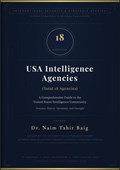
USA Intelligent Agencies
The Architecture of American Power, Secrecy, and Accountability
By Dr. Naim Tahir Baig Ph.D. International Relations | Author of 125+ Internationally Published Books
BOOK DESCRIPTION
In the shadows of the world's most powerful democracy operates an enterprise of extraordinary reach and consequence: the United States Intelligence Community. Comprising eighteen distinct agencies, commanding a combined annual budget exceeding one hundred billion dollars, and deploying a global workforce numbered in the hundreds of thousands, it constitutes the most sophisticated, best-resourced, and most consequential intelligence apparatus ever assembled in the history of sovereign states. Yet despite its scale and its daily influence on the decisions that shape the modern world, this vast machinery of secrets, surveillance, and strategic analysis remains profoundly misunderstood — even by the citizens whose safety it claims to protect and whose taxes fund its operations.
USA Intelligent Agencies: The Architecture of American Power, Secrecy, and Accountability is the definitive, comprehensive, and rigorously researched account of this intelligence community in full — its historical origins, its institutional architecture, its collection disciplines, its analytical methods, its covert operations, its oversight mechanisms, and its transformation under the relentless pressures of the twenty-first century. Written by Dr. Naim Tahir Baig, one of the most prolific and widely read scholars of international relations and strategic studies working today, this work offers both the academic rigour demanded by scholars and the narrative accessibility required by the informed general reader.
A Journey from Washington's Spy Rings to Artificial Intelligence
The book traces the extraordinary arc of American intelligence from its founding moment: George Washington's Culper Ring, which deployed invisible ink, dead drops, and numerical ciphers across British-occupied New York, and whose intelligence was instrumental in the survival of the Continental Army. It moves through the institutional births of the nineteenth century — the Office of Naval Intelligence in 1882, the Military Information Division in 1885 — and through the transformative crucible of two world wars, which gave rise to the Black Chamber's codebreaking triumphs and the Office of Strategic Services, America's wartime predecessor to the modern CIA. The landmark National Security Act of 1947, which created the CIA and the National Security Council, receives the sustained analytical attention it deserves as the constitutional moment of modern American intelligence. So too does the Cold War expansion that produced the NSA, the DIA, the NRO, and the NGA — the institutional pillars of a global surveillance architecture without historical parallel.
The Eighteen Agencies — Each Examined in Depth
No other single volume provides as systematic and detailed a treatment of all eighteen members of the Intelligence Community. From the CIA's five directorates and its Counterterrorism Center, to the NSA's dual SIGINT and cybersecurity missions, to the NRO's classified satellite architecture, to the NGA's geospatial intelligence capabilities — each agency receives dedicated analysis of its history, structure, legal authorities, core missions, and relationship to the broader Community. The military service intelligence elements — Army, Navy, Marine Corps, Air Force, and Space Force — are examined not as peripheral appendages but as integral components of the intelligence enterprise. The departmental intelligence offices of State, Treasury, Energy, and Homeland Security are afforded the scholarly attention they rarely receive in works of this type.