
- ISBN
- 9798231396214
- Genre
- Algemeen
- Verschenen
- 28-02-2026
- Bindwijze
- Ebook EPUB
- Taal
- Engels
- Uitgever
- ?Greatness University Publishers
- Auteur(s)
- Dr Patrick Businge ; Dr Clyde Rivers ; Julian Businge
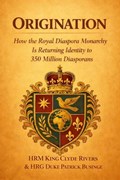
Origination: How the Royal Diaspora Monarchy Is Returning Identity to 350 Million Diasporans is not merely a book about monarchy. It is a civilisational thesis.
At its core lies a profound question: What happens to identity when a people are scattered across continents, generations, and histories — yet remain bound by origin? Across the globe, more than 350 million people of African descent live outside the geographical boundaries of the continent. Many carry fragments of ancestry but lack a cohesive framework for belonging. Origination argues that diaspora is not the loss of identity - it is the interruption of it. And interruption can be restored. Through philosophical reflection, historical insight, and ceremonial imagination, the book introduces the Royal Diaspora Monarchy as a non-territorial model of kingship. This monarchy does not claim land. It claims lineage. It does not rule through borders. It governs through consciousness. It is a throne of identity rather than a throne of power.
The work begins with Africa not as a political entity, but as the origin of humanity itself. If Africa is the birthplace of humankind, then African identity is not regional; it is foundational. From this starting point, the authors explore how displacement through slavery, colonialism, migration, and modern globalisation fractured visible structures of belonging while leaving ancestral continuity intact.
Origination reframes monarchy as a structure of dignity. In this vision, royalty is not about dominance, but about sacred responsibility - the responsibility to guard heritage, preserve memory, and restore honour to identity. The Royal Diaspora Monarchy emerges as a symbolic and philosophical framework through which diasporans can reclaim a sense of rootedness without denying the complexity of their present realities. Rather than romanticising the past, the book constructs a forward-looking architecture. It proposes that identity must be consciously cultivated across generations. Through ceremony, recognition, education, and moral discipline, diaspora can evolve from fragmentation to formation.
The authors argue that belonging is not merely geographical; it is metaphysical. Identity is not defined solely by citizenship or passport, but by origin and continuity. The Royal Diaspora Monarchy therefore operates as a unifying narrative - a moral and cultural canopy under which dispersed peoples may rediscover shared ancestry while honouring diverse lived experiences.
Central themes include:
• Africa as civilisational origin
• Kingship as sacred stewardship
• Diaspora as interruption, not erasure
• Honour as a structured moral practice
• Identity as continuity across time
• Monarchy as consciousness beyond borders
Origination also addresses the modern crisis of identity in a hyper-globalised world. In an era where belonging is often politicised or commodified, the book proposes a different pathway: dignity rooted in origin, strengthened by discipline, and transmitted through legacy. This is not a political manifesto. It is a philosophical restoration. Through its structured argument and symbolic vision, Origination invites readers to reconsider what it means to belong — not only to a nation, but to a lineage; not only to a community, but to a civilisational story that began long before modern states and will endure long after them.
For diasporans seeking coherence. For leaders seeking moral architecture. For institutions seeking continuity.
Origination offers a throne not of territory, but of identity. In a kingdom without borders, origin becomes destiny.