
- ISBN
- 9798233493621
- Genre
- Algemeen
- Verschenen
- 08-03-2026
- Bindwijze
- Ebook EPUB
- Taal
- Engels
- Uitgever
- ?John Pritchett
- Auteur(s)
- John Pritchett
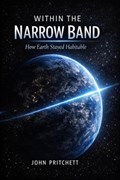
Earth is often described as a "Goldilocks planet," perfectly balanced for life. But Earth's history tells a far more turbulent story. Ice ages, asteroid impacts, atmospheric upheavals, and mass extinctions repeatedly pushed the planet toward collapse. Yet life persisted, and over billions of years complexity emerged.
Within the Narrow Band explores why.
Drawing on planetary science, geology, ecology, and astrobiology, this book examines the conditions that allowed Earth to remain habitable long enough for complex life to develop. It shows that habitability was never a single perfect state. Instead, it depended on many variables—distance from the Sun, axial tilt, atmospheric chemistry, tectonic recycling, ocean circulation, and biological feedbacks—remaining within narrow ranges over immense stretches of time.
Earth did not avoid extremes. It avoided their synchronization.
Because destabilizing forces rarely arrived at the same moment, the planet remained within a narrow band where recovery was possible and life could continue building on itself. Over time, slow geological processes, planetary feedback systems, and the evolving biosphere worked together to stabilize conditions and prevent permanent collapse.
Understanding how this fragile stability emerged reveals something deeper about our planet and the nature of habitability itself. The conditions that allowed complexity to arise were not guaranteed. They were maintained through interacting systems that resisted drift, absorbed shocks, and preserved continuity across deep time.
Within the Narrow Band offers a new way to think about Earth's history and the rare circumstances that allowed life to become something remarkable.