
- ISBN
- 9798232527143
- Genre
- Algemeen
- Verschenen
- 23-02-2026
- Bindwijze
- Ebook EPUB
- Taal
- Engels
- Uitgever
- ?Matteo Bellori
- Auteur(s)
- Matteo Bellori
In many contemporary discussions, meaning is treated as a subjective experience, a psychological motive, or a personal choice. At the same time, the loss of meaning is consistently associated with vulnerability, disintegration, and structural breakdown across personal, social, and technical domains. This book proposes a different approach.
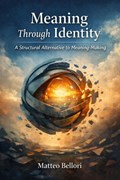
Meaning Through Identity develops a structural account of meaning derived from a more fundamental principle: identity understood as preserved coherence under change. Rather than defining meaning in terms of intention, value, narrative, or emotion, the book argues that meaning arises as a functional effect of successfully integrated change within preserved coherence.
Identity is not treated as a fixed core or essence, but as a bounded process that maintains internal coherence within tolerance limits. Meaning, in turn, is not an independent force or goal, but a second-order structural effect of how identity accommodates change. Where change is integrated, meaning increases. Where integration capacity declines, meaning diminishes — even if identity formally persists.
The framework is domain-independent and non-teleological. It applies not only to human experience, but to biological systems, organizations, and technical structures. By repositioning meaning as a structural phenomenon rather than a psychological construct, the book offers a coherent alternative to traditional theories of meaning-making, existential accounts, and purely semantic approaches.
This work is intended for readers interested in philosophy, systems thinking, identity theory, and the structural conditions under which meaning can exist.