
- ISBN
- 9798233865220
- Genre
- Algemeen
- Verschenen
- 21-12-2025
- Bindwijze
- Ebook EPUB
- Taal
- Engels
- Uitgever
- ?Michael Dente
- Auteur(s)
- Michael Dente
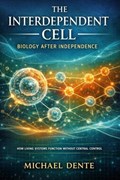
Modern biology has explained life by breaking it into parts—genes, pathways, signals, and mechanisms. This approach revealed extraordinary detail, yet it left a central question unresolved: how living systems maintain coordinated stability over time.
The Interdependent Cell reframes biology at the level where it actually functions—not as a collection of independent components, but as a system sustained through interdependence, alignment, and shared conditions.
Rather than focusing on control, intention, or isolated causes, this book examines how cells remain sensitive to gradients, boundaries, timing, and physical context. It shows how regulation emerges without central command, why compensation replaces regulation under chronic stress, and how disease appears as the visible outcome of prolonged misalignment rather than sudden failure.
Without opposing established science or invoking metaphysical explanations, the book offers a systems-level framework that connects molecular biology, physiology, and medicine through a single organizing principle: coordination precedes function.
Topics explored include:
Written in a calm, non-dogmatic tone, The Interdependent Cell does not argue for a new belief system. It offers a clearer lens—one that explains why chronic conditions persist, why recovery is often nonlinear, and why restoring conditions can be more effective than forcing outcomes.
For readers interested in:
The Interdependent Cell presents biology not as a machine to be fixed, but as a coordinated process that endures through participation.