
- ISBN
- 9798233615979
- Genre
- Algemeen
- Verschenen
- 06-10-2023
- Bindwijze
- Ebook EPUB
- Taal
- Engels
- Uitgever
- ?S. R. Patwa
- Auteur(s)
- S. R. Patwa
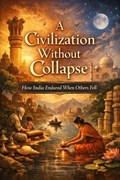
A Civilization Without Collapse: How India Endured When Others Fell explores the remarkable continuity of Indian civilization, offering a thoughtful examination of how a society survived and thrived across millennia while other great civilizations rose and disappeared. Unlike histories that focus solely on empires, conquests, or political events, this book emphasizes the enduring structures, cultural frameworks, and adaptive practices that allowed India to maintain cohesion and identity despite repeated challenges. It is a study of resilience, not in abstract terms, but grounded in the lived experience of villages, households, guilds, and communities.
The book begins by examining the broader question of civilizational survival, situating India in a global context where many societies collapsed under internal weakness, external invasion, or social disintegration. It moves beyond conventional definitions of collapse to explore how continuity often resides in practices rather than institutions, in memory rather than archives, and in moral and social frameworks rather than political power. By doing so, it presents a nuanced understanding of what it means for a civilization to endure.
Readers are guided through India's decentralized village structures, the role of dharma in sustaining social cohesion, and an economy that remained resilient without relying on continuous centralized authority. The chapters illuminate how education was transmitted without formal universities, how pluralistic religious and philosophical traditions fostered coexistence without rigid institutions, and how scientific and technical knowledge was embedded in daily life, from agriculture and architecture to medicine and metallurgy. The text also examines the psychology of continuity, exploring how collective memory, individual identity, and concepts of time and self contributed to civilizational stability.
The book further analyzes India's ability to absorb shocks, including invasions, migrations, and colonial rule, without losing its essential character. Women, family structures, and household institutions emerge as crucial transmitters of knowledge and values, ensuring that social and cultural continuity persisted even when political regimes changed. Through the lens of history, the text demonstrates that empires may fall, but the underlying civilizational fabric can endure.
Finally, the book draws lessons for the contemporary world, emphasizing patience, adaptability, rootedness, and cultural depth as tools for resilience. It invites readers to reflect on how modern societies can learn from a civilization that has navigated complexity, conflict, and change without succumbing to collapse. Combining historical insight, cultural analysis, and philosophical reflection, A Civilization Without Collapse is both an exploration of India's past and a meditation on enduring human resilience.