
- ISBN
- 9798233835308
- Genre
- Algemeen
- Verschenen
- 10-01-2026
- Bindwijze
- Ebook EPUB
- Taal
- Engels
- Uitgever
- ?Udaya R. Tennakoon
- Auteur(s)
- Udaya R. Tennakoon
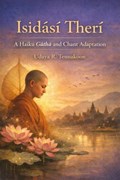
Isidasi Theri: A Haiku Gatha and Chant Adaptation presents a contemplative re-rendering of Therigatha 15.1, one of the most striking autobiographical poems in early Buddhist literature. Attributed to Isidasi Theri—an arahant nun of the early Buddhist Sa?gha—the original verses recount a life marked by repeated rejection, karmic consequence, renunciation, and ultimate liberation.
Rather than offering a linear translation alone, this book adapts Isidasi's extended narrative into forty-eight haiku-like gatha. Each poem functions as a discrete unit of reflection, designed to be read slowly, contemplated, or recited. The minimalist poetic form mirrors early Buddhist pedagogical strategies, in which brevity, repetition, and silence serve as vehicles for insight rather than ornamentation.
The work is framed by a scholarly yet accessible introduction situating Isidasi's verses within the Therigatha corpus and early Buddhist ethical philosophy. Particular attention is given to the doctrine of kamma (intentional action and its consequences), rebirth, and the known tension between present moral conduct and inherited suffering. Isidasi's account challenges simplistic notions of moral causality, demonstrating instead how past intentions may mature across lifetimes, even when one's present actions are virtuous.
Through her attainment of the threefold knowledge (tevijja), Isidasi reflects on her previous births, tracing how desire, jealousy, and misconduct once shaped conditions that later manifested as suffering. Crucially, her narrative does not culminate in guilt or fatalism, but in clarity. By fully understanding the causal structure of suffering, she relinquishes its conditions and attains liberation (nibbana).
Supplementary materials—including a prologue, epilogue, glossary of Pali terms, and notes on chanting and contemplative reading—frame the poems as both literary expression and spiritual practice. While grounded in Buddhist studies, the book also speaks to readers in comparative literature, philosophy, and contemplative traditions.
By presenting Isidasi's voice in a distilled poetic form, this adaptation offers a bridge between ancient text and contemporary reflection. It invites readers not only to study a foundational work of women's spiritual literature, but to engage it as a living inquiry into suffering, causality, and freedom.